Resistance: An Introduction (Issue #4)
By Hugo Benavides
We starve, look at one another, short of breath
Walking proudly in our winter coats
Wearing smells from laboratories
Facing a dying nation of moving paper fantasy
Listening for the new told lies
With supreme visions of lonely tunes
Somewhere, inside something there is a rush of
Greatness, who knows what stands in front of
Our lives, I fashion my future on films in space
Silence tells me secretly
Everything
Everything
“The Flesh Failures,” from Hair: The Musical (1967)
My life changed forever a couple of months ago on July 6th, 2026, when Gregory Allen, my life-partner of 32 years died unexpectedly. As anybody who has suffered an intimate loss knows, the whole landscape of your life and world changes in what seems one magical, vicious, stroke. Gregory was an actor/director, and he accompanied the revival of Hair in 2008 at the Public Theatre in New York City. This allowed him and I to see multiple productions of the musical, first at the Delacorte in Central Park, then on Broadway, and finally at the West End in London.
The musical, especially the lines from its concluding song, The Flesh Failures, seem as relevant today as when they were written half a century ago. The lyrics address a mortally ill nation filled with lies and loneliness. Only a counter assertion of an interior and attentive silence breaks through the depraved artificial social constructions and annihilatory coercions of a militarized state’s impunity.
I bring together these two elements, the closing lyrics from Hair and Gregory’s passing, to introduce this Cul-de-sac issue on “Resistance.” All the contributions are attempts to think of resistance as complicit forms of embodied aliveness even before they are forms of combat or refusal.
How many times are we not sure where the true enemy or our most crucial opponent may lie? How do we face or resist an enemy we have not clearly defined and is within our own selves? As James Baldwin explicitly cautioned us, it is important to remember that when we are in the midst of an encounter with an authoritarian figure (whether that figure is immediately dressed up as a member of the police, the military, or someone in our family) that figure could have been—or might even be—ourselves.
This ambivalence at the heart of enlivening authentic resistance is present in Doina Sandor’s and Zuko Zikalala’s collaborative essay. Their contribution explores resistance with several vignettes and poetry, highlighting how personal experience both defines and complicates what resistance is. Their contribution does not shy away from the terrifying question of how the specter of complicity shadows resistance. How often and how fatally are we sometimes our own worst enemy?
These tensions are also present in Diane George’s contribution. Her essay reminds us, as do the lyrics of “The Flesh Failures,” that the evils of American empire are neither new nor surprising. The genocidal exploitation of millions has been at the center of empire from the beginning. As she notes, this can be traced everywhere from archaeological records to the latest science fiction. Multiple domains create a matrix within which resistance and its contradictions play themselves out.
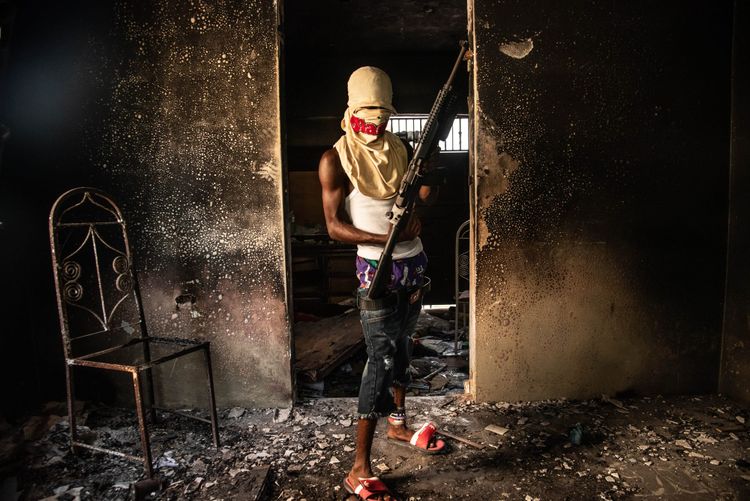
Héctor Quintanar’s and Kelly Kimball’s contributions on “Child Combatants in Haiti” and a “failed strike” at the Delaney Hall ICE detention center graphically engage other unsettling factors of resistance. Quintanar’s text and images shockingly express a world where children are used as the weapons in their mutual murder and self-destruction. How do we inhabit and remain complicit in the processes of globalization that produce the ongoing crimes and atrocities being perpetrated in Haiti and Palestine? The self-identifications we are forced to make in viewing Quintanar’s images work against the coercions of denial.
The supposed strike failure at Delany Hall, described by Kimball, highlights the question of what is or is not successful when it comes to resisting evil. Is the fact that the initial objectives were not achieved, or the fact that the resistance there is on the brink of being erased from public memory, potentially important to an understanding of resistance’s eventual success? The article provocatively asks if resistance is ever actually faithful to its objective. May discontinuous and opportunistic transgressive breaks in hegemonic domination be less illusory than we think and provide promising paths, however small, of liberation?
Finally, our managing editor, Peter Dimock, attempts to offer insight into the process of resistance and its chronicling through the publication of Cul-de-sac. The title of our journal is explored by Dimock as a tribute to print’s paradoxical ability to simultaneously acknowledge and refuse continuously hopeless situations that must be—and have been—continuously opposed. He also rightfully highlights how this process (of assertive opposition) must continue to be done through reading and the technologies of literacy (even if the book as authoritative force is transformed and appropriated by extractive technologies of command and control). Cul-de-sac is yet one more attempt to connect us again, in enlivening solidarity and in language, to the flesh failures that we all are.
I hope by now it is a bit clearer why I have used Greg’s passing and the lines from “Flesh Failures” to frame this issue of CDS on resistance. For me, both presage what resistance might feel and look like for many of us. The very fact that I got out of bed this morning and found enough hope to write this “Introduction” is for me an enormous act of resistance, an act of resistance that is constituted both from and against, within and without, and in which I feel guiltily, disturbingly complicit in a myriad of ways. A few weeks ago, I knew for a fact that I would not survive Greg’s death, and here I am, still resisting. But the fact is that Greg’s passing has allowed me to understand many things, including that “Silence tells me secretly /everything, EVERY THING!”
Member discussion